Just to give one a brief background of this show, Sayonara Lara is a story that pays homage to Hans Christian Anderson’s, The Little Mermaid, with Lara also having five older sisters, a fascination with humans, and her turning into foam after her love was found to be unrequited. Other differences are that the mermaid kingdom in Sayonara Lara forbids contact with humans and even items made by humans instead of having a fascination with them, believing them to be vile, cursed beings who will taint the light that resides within the mermaids, which may or may not be their souls or at least what they have in place of souls with all mermaids having one rebirth in their individual lives. It appears that once every generation there’s a mermaid who possesses a spectacular light that powers the kingdom with Lara, Lisa, and Luna’s mother being the previous carrier of that light while Lara currently is the chosen princess that can bring forth that truly amazing light.
Although Lara was surely told not to think of humans often as a child, she nonetheless had a special hideout with all of the human items she collected when she ventured out on her own, and one of them was a disfigured statue of a man bearing some passing resemblance to Julius Caesar, who claimed to be a descendant of Venus of love and desire, and it’s fitting for the story of Sayonara Lara that Lara would fall in love with a human, showing that the director and writer of the story very much paid attention to the details of the story in choosing a statue of someone who claimed to have an association with Venus.
On to one of my main points, I very strongly doubt that the mermaid kingdom in this story always had the stance that humans are vile, cursed beings since the designs from some of the mermaid kingdom buildings weren’t so alien that they couldn’t have been inspired by human designs or the other way around, and more to backing this up is that at 2:08 in Ep. 1, the mermaid kingdom has deep-sea tramways, and aerial tramways may have been influenced by deep-sea tramways or vice-versa. Additionally, Lara after she’d taken Grace’s potion had also stepped foot on a human ship with one of said ships during 13:45 of Ep. 1 even being ordained with a mermaid at the bow of the ship, which suggests that mankind and merfolk didn’t always see the other as vile, as there were probably those in the royal family who had some degree of fascination and even intermingled with mermaids in the past. More to back this up is that in Ep. 1, the unnamed prince Lara fancied was able to see the fish-shaped dagger after Lara died, which I’m guessing is a divine instrument of some sort, and given no others aside from Lisa, Kouta (from Ep. 3), and Lara herself could see the fish-shaped dagger since not even Mari could, this possibly suggests that only those who are mermaids, their servants possessing their favour, or descendants of mermaids can see the fish-shaped dagger, and assuming this theory is correct, the unnamed prince could’ve been a legitimate descendant of mermaids, and that’s the reason he could see the divine instrument.
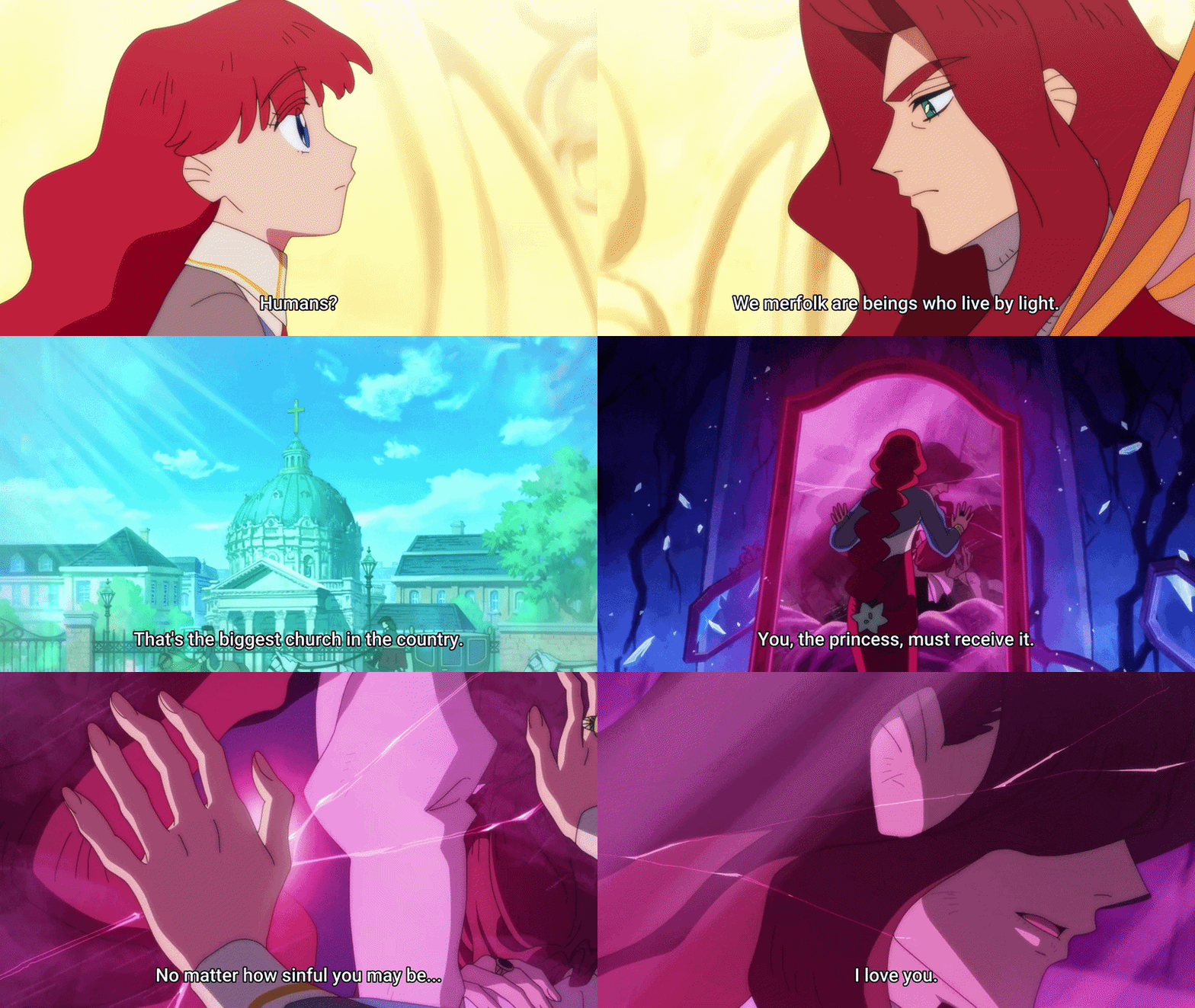
And I am going somewhere with this in that I believe much like how lepers were associated with sin and how the Western medieval Church heavily institutionalized the spiritual stigma during the 11th and 12th centuries, formally barring lepers from regular community gatherings, church gatherings, and marketplaces, deliberately targeting them for isolation due to the perception of them being sinners, the merfolk in Sayonara Lara may have associated humans with sin due to a bad experience in which their kingdom lost its light due to an instance of unrequited love from a chosen princess in the past, and as time passed, the merfolk forgot the reason they stayed away from humans, having come to associate humans with sin in general.
Thus, my point with this GIF is that I believe the director and the writer of this series are directly criticizing the Church for having done that, and they believe that Jesus teaching to love your neighbour as yourself, meaning love for others flows from love for God is second only to loving God, with Jesus having noted the basis of all Biblical scripture and thoughts prophets depend on are on these two commandments, yet so many people who proclaim themselves to be Christians today literally actively seek to hurt others and treat them as lesser ’cause they don’t fit into their worldview of what constitutes a person worthy of deserving God’s love despite it being characterized by boundless mercy and the forgiving of slights, an active sacrificial force prioritizing the redemption of humanity. Jesus defined a neighbour as anyone in need who has crossed your path, regardless of your differences, and it’s your responsibility to act with mercy and become a neighbour to others.
In Ep. 1, we see three (one of which was extremely notable) very notable instances of choosing to love one’s neighbour with Lara choosing not to react with anger to the prince she fancied when he rejected her and when Rowan chose to give the last of the light within him to Lara knowing she would one day be reborn. Lara still chose to look at the prince with kindness in trying to communicate what she felt for him through her face even though she did also try to through her words and couldn’t due to Grace having cut out her tongue before sending her to the surface world. Rowan still chose to give Lara the remaining light within him even though she broke the laws of the mermaid kingdom and was a sinner in his eyes, which is why he had intended for her to spend her time in a jail cell until one hundred mornings had passed, since he probably believed Lara would be very alone when she eventually experienced her rebirth. The last instance of the second greatest commandment in action in Ep. 1 is Lara feeling sorry for having wished to become human due to what happened to her family, saying that she’ll offer her very life and body to bring them back with her tears having a tinge of red at 19:51, which is the colour of Christ associated with his sacrifice, and given the significance of Lara offering her body to bring back her mermaid family, I doubt that this was a coincidence but something extremely intentional with Lara taking on a similar role that Jesus was said to have taken for mankind, only in a different manner.
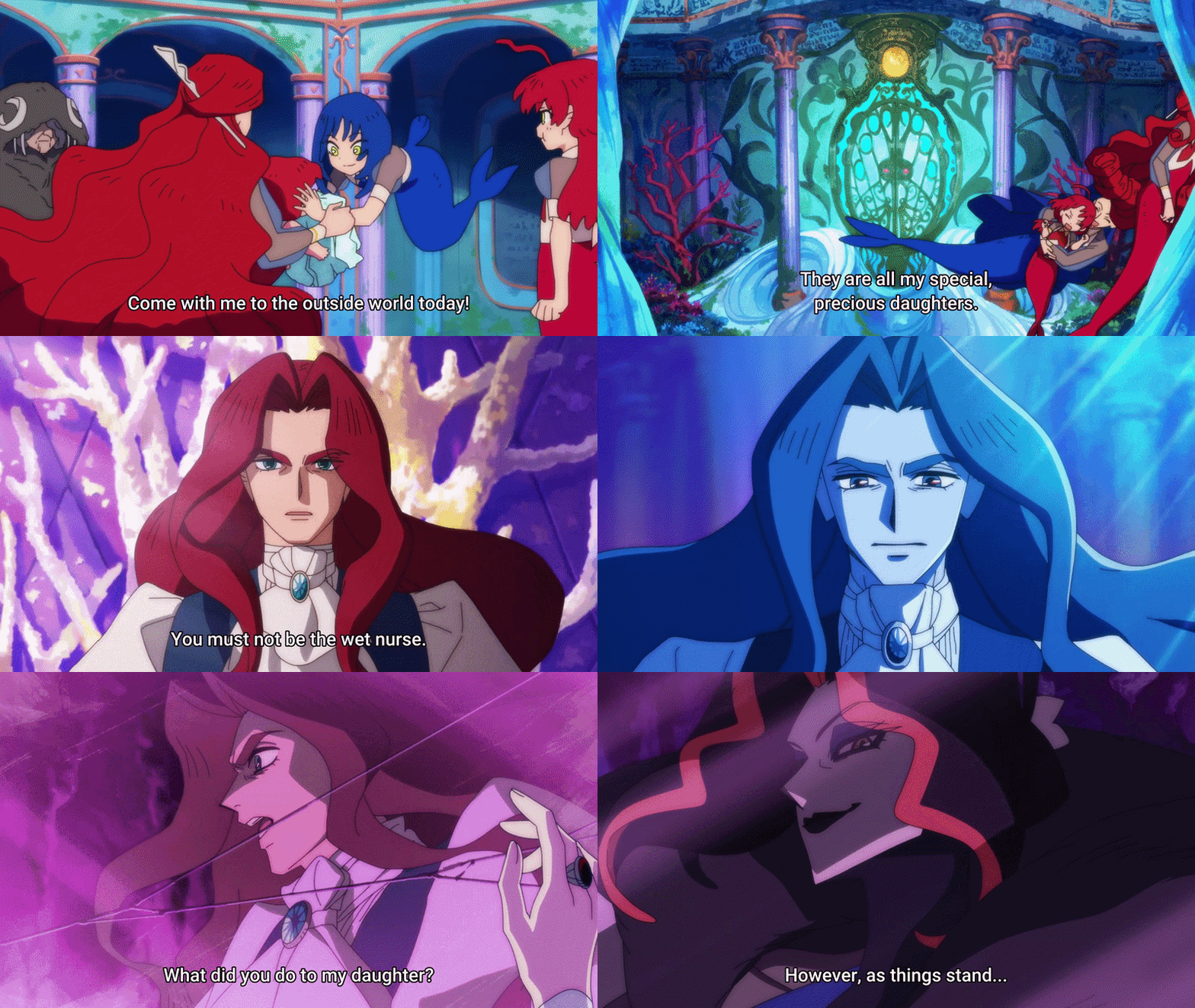
For this GIF, I’m counting all the non-miniscule points on Rowan’s neck brooch that reach the end of the blue part of the brooch as points of an irregular-shaped star with all of the instances I’m referencing coming from Ep. 1. At the start of this GIF, we see Grace in disguise who seems to recognize a prophecy in action with Lara’s first trip outside the palace resulting in her coming across a human doll. At 2:40, Rowan’s brooch has 6 points, and the biblical significance of 6 is human imperfection in that it symbolizes falling short of God’s holy standard, meaning the scene intends to portray Grace as in the right for wanting to follow whatever prophecy she is following while Rowan forbids prophecies.
At 2:46 when recognizes it’s Grace instead of the wet nurse, his brooch has 7 points, and the biblical significance of 7 is spiritual perfection, which could mean that the mermaid kingdom’s laws are what’s lacking with Grace’s having sought human knowledge in the past, as shown by her allusion later in the episode to a quote of one of Jean-Jacques Rousseau’s work in saying that we’re born twice, once to live and once to live, making her closer to God than those of the mermaid kingdom are. For those who don’t know, Hans Christian Andersen was a big fan of Jean-Jacques Rousseau and his belief about the inherent goodness of human nature, so Kinema Citrus has clearly gone all-out in creating this story in a way that Andersen would be proud of if he’d still lived given he was a very religious man and also wrote The Little Mermaid after the man he loved at the time rejected him, and writing Sayonara Lara as a yuri story to pay homage to Andersen not being a straight man is a bold and honourable move. Andersen’s beliefs in the inherent goodness of human nature and that children before they are corrupted by society possessed a sacred, spiritually pure clarity that adults lose due to social conditioning are ultimately why I’m confident that the story is an allegory for the Church treating others who are different with contempt through the merfolk who subscribe to their antiquated beliefs about humans.
At 8:06, with his brooch having 8 points, Rowan asked Lara why she approaches humans the way she does since it goes against their laws, and Lara pushes back, asking if humans really are the vile creatures they believe them to be, and the biblical significance of 8 is new beginnings, which is apt in this situation since Lara finally outright defied Rowan’s authority in visiting the surface world and talked back to him, he who could be compared to a religious authority figure, which is backed by how he decides what is sinful and what isn’t.
At 8:41, Rowan’s brooch has 9 points with one of the biblical significances of 9 being finality, and much like how Jesus was said to have died during the 9th hour (3 PM in modern times), this perhaps marks the moment when Lara became an outcast during her first life as a mermaid even if there was no redemptive sacrifice.
At 17:16: Rowan angrily asks what Grace did to his daughter, and Grace merely replies that Lara chose to take the potion of her own will, and a biblical significance of 10 is that it represents divine order, perhaps showing that Rowan’s horrible teachings led to Lara hating herself, and Grace’s comment earlier in the episode that Lara’s light could become a blade that brings his palace to ruin may have been referencing that very happening with Grace being uninterested when Lara was rejected but very interested in the fish-shaped dagger appearing, which may have been a sign to her that the prophecy was on track.
Finally at 18:06, Rowan’s brooch has 11 points, and the biblical significance of 11 is chaos and disorder, which is relevant in that the merfolk were very unhappy about having to go on a long and arduous journey to find a new home, and even when they found a new home, their light still kept disappearing, leading to most of the merfolk in a state of deep sleep in the modern day with only Lara finding true love being able to reverse their kind’s decline.
More to back up my read about the second greatest commandment being central to Sayonara Lara is that in Ep. 2 Lara awoke to find herself in a place she had never seen before, a modern home, and when she saw Mari, the girl who punched her as she was falling from the sky in Ep. 1, she panicked in fear and jumped out of the window, leading to her seeing a church next to Mari’s house, remembering the prince she fancied two 200 hundred years ago mentioning that churches are the places closest to God’s love, which although isn’t explicitly given meaning in this episode, is a sacrificial love known as agape in the Bible, and what Lara thought of after entering this church is her father, Rowan, sending her the last of his light to her, very much a sacrificial love, which I believe is very much on the nose, showing I was absolutely correct.
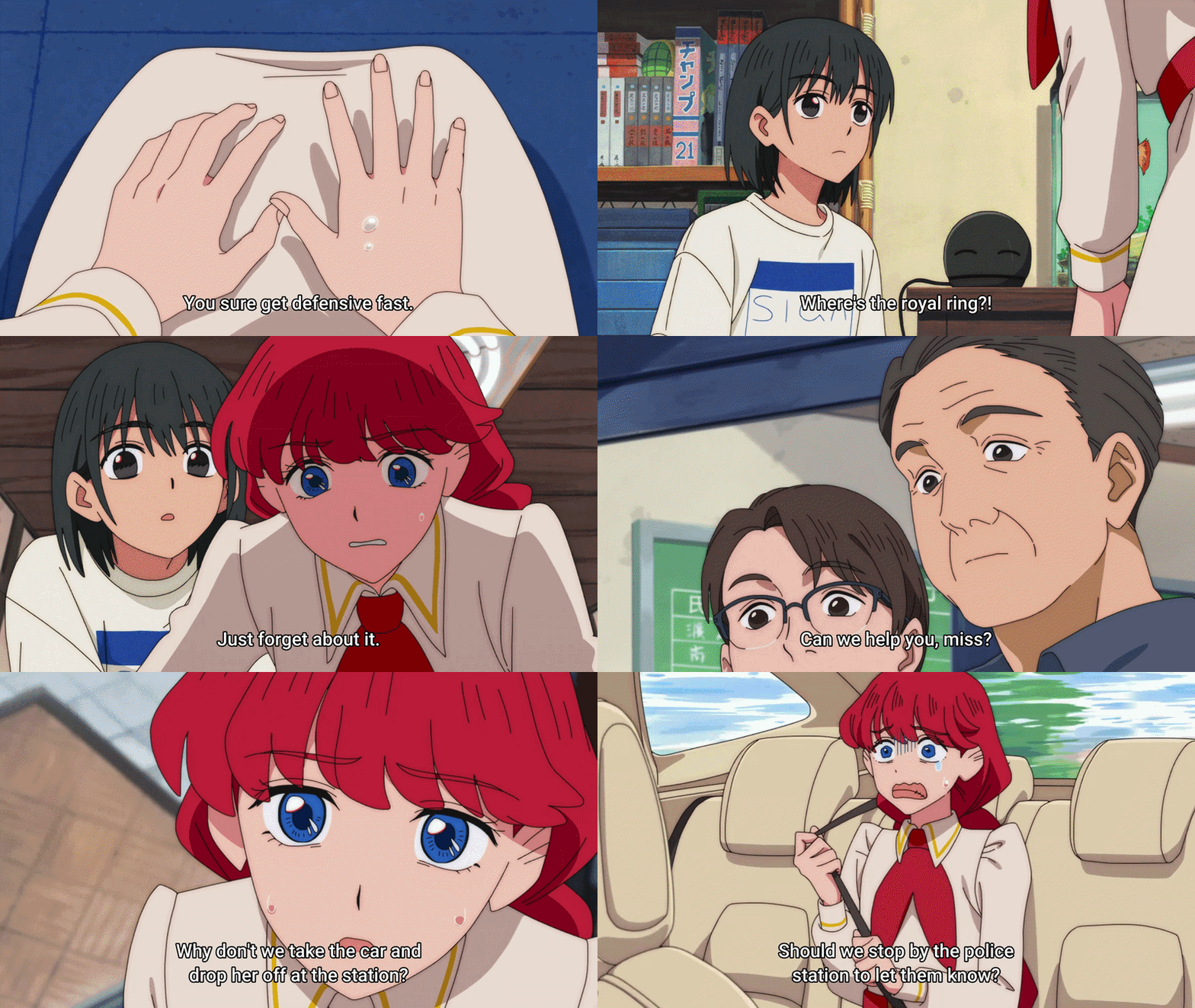
Mari herself also adhered to the second greatest commandment given she took Lara in and had Lara sleep in her (Mari’s) room since the AI assistant in the room, Hal, talked about it being time for Mari’s morning exercise, confirming it was her room, so even though Grace prompted Mari to take her in as shown in the flashback later on, Mari didn’t really need to since she considers Grace her pet even though it’s highly likely that Grace has been manipulating Mari since childhood and knows that she will be Lara’s prince based on how at 2:54 in Ep. 2, a clam appeared on Lara’s head while showing her underwater as she thought about why she ended up at this unknown place, and at 6:55 in that same episode, we see Grace’s true form underwater for a brief time in water that’s not the fish tank, and we even see another magic mirror appear from seemingly nothing from within the fish tank, all of which suggests that Grace is far from helpless right now as a fish and is almost certainly still trying to make the prophecy come true with possibly neither Lara nor Grace’s bodies being their true bodies, meaning Grace may have created makeshift bodies for them, one to guide Mari, and one so that Lara could move about and find her true love, who will almost certainly be Mari given the first scene of Ep. 1 flash forwarded to after Mari had already won her championship title with Lara by her side. Mari genuinely saw somebody in need and decided to lend a hand.
Later on in the episode, Lara and Mari get in an argument, and when it really starts pouring, Mari takes Lara’s hand, and they run off to some building with a vending machine with Mari’s favourite hot chocolate brand. Despite their having been fighting not that long ago, Mari gets Lara some hot chocolate, teaching her how to drink it by example, and it was another genuinely kind moment to offer Lara a warm drink after they’d gotten out of the rain, which is the respectable thing to do, especially since it was not any drink but something that speaks to her, making it truly an example of the second greatest commandment in action.
Now, it’s time for the next part of what I want to talk about, which will include circles, including rings, given circles are important in Christianity ’cause they symbolize eternity and the endless nature of God due to having no beginning or end. The reason Lara and Mari had even gotten into an argument in Ep. 2 was ’cause Mari punching Lara in the first episode led to Lara losing the royal ring that was given to her by her father which was very precious to her given Lisa had told Lara that the ring carries the wish that they find true love, and since wedding rings in Christianity don’t just symbolize an unbreakable lifelong promise and sacred marriage covenant before God but also a reminder of Christ’s sacrificial love for the Church, I believe Lara is meant to break free from her affection for her royal ring due to Hans Christian Andersen rarely having attended formal church services in his life, believing the natural world to be the true “holy church”, often criticizing priests espousing eternal damnation over God’s boundless grace, and my position is backed by how Grace told Lara to just forget about the ring in this episode.
In Ep. 3, there are 3 ways rings factor into the story of the episode. The first being the boxing ring, which used to have circular rings but no longer does but keeps ring in its name partially as a reminder of how it started, since Mari is part of the boxing club at her school and has won a national championship in junior high. Although not strictly tied to Christianity, many actual boxers and analysts of the sport describe the boxing as the loneliest place on Earth given there aren’t any teammates or external shields they can use to hide, forcing them to confront their truest selves and to give their opponents their utmost respect. It’s also seen as more than just mere brutality by them but an artistic and possible even moral test of discipline and focus under pressure. Boxers themselves see the boxing as a sacred space and considering Sayonara Lara is a story with a lot of Christian symbolism and inspiration, I doubt that this was a coincidence in having Mari be an amateur boxer. Mari faltered in her fight against Nagahama ’cause she was distracted by the noise of the gong falling, which reminded her of her mother’s cross falling to the ground and when she lost the person she loved most in her life. It was Lara who came and intervened in the fight as Mari was headed to a loss, the one who uttered that she’d sacrifice her life and body to help others as Jesus did. And given Mari told Lara to keep her eyes on her as she fought, it was inviting Lara into her sacred space, the boxing ring, a metaphor for relying on Jesus to ground her against a hostile audience and also a lesson to Mari to be more considerate of those in the club after Lara asked her if everybody in the room hated her with the situation only getting to that point ’cause Mari would often space out when she was training at the club, leading to her not giving the others as much time to train even though she’s a first-year student and the other students have seniority although it was the club supervisor/coach that allowed for Mari to get the same treatment the older kids got, and Lara’s comment ultimately helped Mari develop better relationships with her club members.
The second way rings factored into the story of Ep. 3 is that Mari’s mom would give baumkuchen to the parents of kids Mari would get into fights with. Baumkuchen’s concentric rings are similar to the growth rings of trees, and baumkuchen was frequently eaten during Christmas to reflect celebration, God’s bounty, and hospitality during the darkest days of the year, and if you loosely apply this to Sayonara Lara, it makes sense why Mari’s mom gave out baumkuchen as an apology gift whenever Mari hurt a kid, making it a dark day, since she was a Christian.
The last way a ring factored into Ep. 3 was that the bag that Mari’s mom bought the baumkuchen in featured 4 concentric circles. While one might think it’s just referencing baumkuchen resembling the growth rings of trees, 4 concentric circles in Christianity refers to the expanded Theological Triage framework used to categorize doctrines by importance with the bull’s-eye/center ring being the Absolutes/Dogma, as in the core beliefs of Christianity, such as the Trinity, the deity and humanity of Jesus, the resurrection of Jesus, and salvation by grace. The second ring denotes denominational convictions that separate major branches of the church, such as views on sacraments (infant baptism vs. believer’s baptism), church governance, and ordination with views on marriage and sexuality residing here, dividing affirming denominations from traditional ones. The third ring denotes opinions, such as specific views on creation or precise methods of biblical interpretation that aren’t considered worth dividing churches over, and the outer ring denotes questions, which are unsettled, speculative, or personal matters where Scripture is silent on or vague about that have very minimal impact on core faith.
Where I’m going with this is that given the gorgeous waterworks that appeared after Lara heard from Mari that she likes her, I view that as a sign of Lara overflowing with love in her heart for Mari although Lara doesn’t realize that due to almost certainly having been raised to believe that marriage is between man and woman by her father, and Ep. 5 showing the giant fish dagger, which I believe to be a divine instrument, either attacking or warning Kouta due to the perceived threat to her loved one that Lara felt as a result of Lisa insinuating that she’d have Kouta kill Mari and her family was a nod to that. That is to say that the director and the writer consciously chose to honour Hans Christian Andersen’s bisexuality and his indifference to the institution of the Church by daring to suggest that gay marriage isn’t dogma or a core belief of Christians. Mari deciding to keep Lara around even though her mother had wanted to kick Lara out due to all the trouble she caused ’cause Lara truly had nowhere to go was another example of the second greatest commandment being relevant.
How a circle was relevant in Ep. 4 was that Himeka and Ouji’s situation was somewhat of a mirror of Lara’s situation in the past with the prince she fancied. Lara was unable to tell him how she felt due to her tongue having been cut, and that weighed on her, and having grown as a person since her rebirth, she told Himeka to tell Ouji how she felt since Lara would’ve wanted that for herself 200 years ago, making it another example of that commandment being followed, which I believe was fully intentional from Kinema Citrus in giving her a full circle moment.
And the director and the writer even carefully crafted the original scene with Lara and the prince 200 years ago on the spiral staircase at 13:49 given in Christian architecture, a spiral staircase symbolizes a spiritual journey toward God, but the finite nature of that staircase ended up matching up with the end of Lara’s first life, and since she had been reborn since the end of Ep. 1, one can make the analogy that the staircase of life never ends in contrast to finite spiral staircases, meaning Lara will be able to use her past experience in her second life to reach for higher heights than she did before.
When Mari and Lara were shopping in Ep. 4 toward the end of the episode, Mari asked Lara to focus on finding the freshest oyster, and given the oyster represents female bodily autonomy, reclaiming it from its historical patriarchal framing, I doubt this is a coincidence and may be pointing to Lara having great taste in girls/women.
In Ep. 5, Lara and Mari got part-time jobs at the same cake shop, Andeken, which is a real cake shop in Japan in the Shiga Prefecture with the focus being entirely on Lara, and given how she was extremely eager to make cake, the manager allowed her to help him test out a new product, a peach tart, and it was a real grind across a period of over a week. Lara had considered quitting after all the hard, manual labour she had to go through, especially given she wanted to be paid enough so that she could fully repay the damages she’d caused to Mari’s house, but after snapping pictures as she’d learned to do at the start of the episode and remembering the memories she had with everyone, she came to work with a renewed sense of purpose and feeling of kinship with her co-workers since she got to see other sides of them and learn more about humanity, which she had wanted to do all her life. A spiritual metaphor for peaches is that the hard core represents the resilient core of a heart surrendered to God after undergoing life’s trials and pruning, and one can see how this applied to this episode in that Lara felt closer to reaching the true love she needs to in after allowing herself to be swept up by what came her way instead of insisting on needing to search for her true love immediately, having shared that with Mari on the train back home.
This also makes the shopping for oysters content in the previous salient in that much like the hard core of the peach, the oyster species humans consume for food rarely have pearls in them, and if they do, they’re rather unrefined, but nonetheless, like the species farmed to create pearls, pearls are created from foreign entities invading the oyster with the oyster’s handling the incursion with its defense system being what ultimately results in a pearl being formed, making oysters a metaphor for how hardships and trials in life are what build inner character in humans. Of note are that oyster shells have growth rings too, much as trees do, so one can see how an oyster grew over time and see when an oyster experienced hardship, such as during the winter.
At the end of the episode, Lara had an encounter with Lisa that was almost certainly planned given Lisa and Kouta had been stalking Lara, and Lisa reveals that the reason she took so long to reveal herself to Lara was that she was disgusted by her human form, and consequently, Lara’s as well even if Lisa didn’t outright say that, but the subtext was there. She declared that she wouldn’t allow Lara to love a human, hinting that she was sending Kouta to murder Mari and her family, and Lara heard the message loud and clear, showing deep concern for Mari’s well-being, resulting in the fish dagger/divine instrument descending to the bridge on which Kouta was driving with Kouta’s fate being unknown after that aside from his car being totalled.
Given Eps. 1 and 5, I believe the divine instrument reacts to threats against Lara’s loved one and her well-being, and that’s why the mermaid kingdom was damaged structurally along with the light fading from the palace ’cause the merfolk’s teachings led Lara to hate herself when she just had a basic curiosity with humans, and there was nothing wrong with that, but her father telling her that humans are vile led to Lara believing herself to be vile after the prince she fancied turned that back on her by calling her mermaid form vile, and thus, I posit that Ep. 1 was meant to portray that the mermaid kingdom and the prince, not Lara, sinned, and Lara choosing to give her body to revive the mermaid kingdom was meant to have her redeem them even though the last thing she’d remembered was being hated by a human, which she had lingering regrets and a trauma over given she shared with Mari that she was afraid of being hated by humans again in Ep. 3. And so, I believe one of the points of Sayonara Lara‘s story is the redeeming of the merfolk and even the prince through Lara if the mermaid heritage I propose the prince had results in him being revived due to their behaviour sullying the pure, childlike wonder of the chosen princess, Lara, 200 years ago.
I’ll conclude this post by pointing out something big which I believe nobody else on the Internet has realized, and that’s the reason for Kouta having a male body despite Lisa’s deep-sea anglerfish companion in the past having two moles to the left of her left eye and one lower and to the right of the same eye at 7:29 in Ep. 1 with the male Kouta also having those same moles as shown by Episodes 2 and 5. I believe it was a male deep-sea anglerfish that mated with that female deep-sea anglerfish companion that was revived due to male deep-sea angerfish biting female ones to mate with them having their mouths and skin dissolved with most of their internal organs wasting away, surviving purely as an entity dependent on the female for nutrients ultimately as a source of sperm. Why this is relevant is that it’s argued in the New Testament that nothing really points to men being the head of the household with kephale referring to “leader” or “source/origin” with Eve being seen as an equal partner to Adam despite Eve having come from Adam, and Paul indicating that husband and wife should equally submit to the other. This would explain why Kouta’s mouth is stitched together if his mouth had dissolved when he was a deep-sea anglerfish.
Where I’m going with this is that this series is likely taking agape, self-sacrificial love, seriously with the male deep-sea anglerfish being reborn over the due to the male sacrificing himself to provide sperm to the female, and that’s why I posit Kouta was chosen to be reborn over the female deep-sea anglerfish due to fish also having growth rings as trees do with male deep-sea anglerfish no longer having growth rings after fusing physically with female ones, which is akin to male ones being erased to serve females one, and that’s why Kinema Citrus possibly made the decision it did to make Kouta male albeit with the same moles as that of Lisa’s female deep-sea anglerfish companion to honour that before Kouta’s revival, the female one was the host fish, paying tribute to the female through Kouta’s design.
Suffice to say, I believe an extreme amount of care was put into creating Sayonara Lara, and I believe that based on all the themes and subject matter covered, it’s the series with the most ambitious story of the Summer 2026 season, and it’s pushing the envelope for what anime as an artform can be with its distinct artstyle for its era and the deep thematic exploration going beyond what other anime have covered this season presented in a lovely, amiable package that Christians and even non-religious folks can enjoy if they meaningfully engage with the subject matter.